Execution Stability, Delivery Ownership.
When growth outpaces control and leadership needs certainty.
Regain clarity and restore accountability.
The Problem Pattern
Scaling
Chaos
Teams and vendors are siloed
Leadership
Ambiguity
Decision and authority dissolves
Delivery
Risk
Accountability and revenue drift
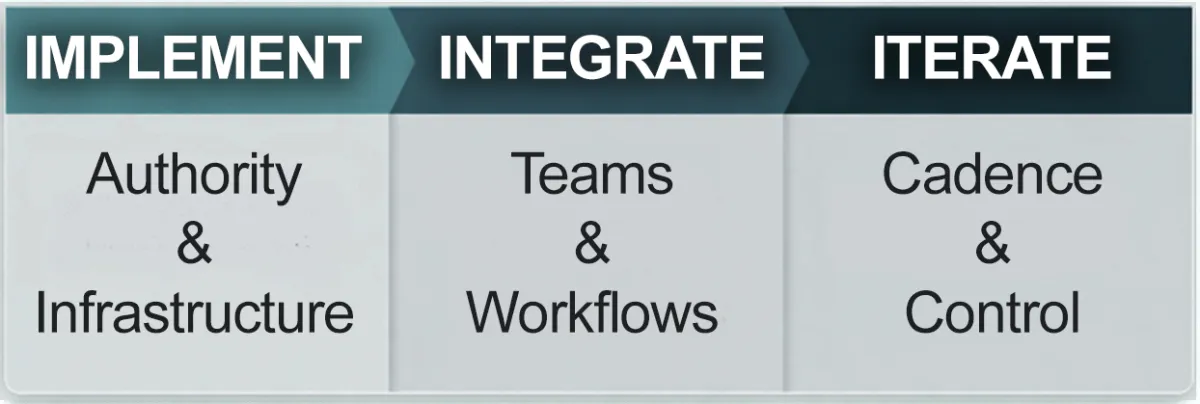
How Execution Stability Is Restored
Within the first 90 days
Is This Right For You?
Best Suited For
Post-scale or post-merger
Current execution instability
Urgent need to regain control
Not Designed For
Early-stage startups
General consulting projects
Companies "just exploring"
How Engagements Work
Entry via Assessment Request
Time-bound stabilization period
Extensions only when warranted
Proven Stabilization Results
Delivery operations aligned to revenue targets within 90 days
Integrated fragmented PMOs to unified ongoing execution
Restored operational control after rapid growth
Establish Control
Before the cost compounds

Regain clarity and restore accountability.
The intake call is to assess fit and urgency. Not all situations are a match.
FAQ
How exactly does Imtegrit enter an organization?
Imtegrit enters with a defined mandate to establish execution clarity and control.
Engagements begin with an Execution Assessment — a focused, time-bound intervention designed to surface where delivery ownership, decision flow, or operating cadence has drifted from reality. This is not a generic diagnostic or advisory exercise.
If stabilization support is warranted, Imtegrit assumes executive-level responsibility for restoring execution integrity across delivery, operations, and cross-functional alignment.
What happens during an Execution Assessment?
The Execution Assessment establishes a single execution truth.
We examine how commitments are made, how work actually flows, where authority breaks down, and where risk is accumulating between sales, delivery, and leadership. This includes reviewing decision rights, operating cadence, delivery governance, and accountability structures.
The outcome is not a report — it is a clear determination of:
-Whether execution risk exists
-Where control has been lost
-Whether intervention is required
Not all situations are a fit. The assessment is designed to make that clear quickly.
What conditions make this work — or not work?
Imtegrit works best in environments where execution matters immediately.
This typically includes:
-Post-scale or post-merger organizations
-Regulated or high-risk operating environments
-Leadership teams experiencing delivery instability or loss of control
-Situations where execution failure carries real financial or reputational cost
This does not work for:
-Early-stage companies still searching for product-market fit
-Organizations seeking general consulting or strategy advice
-Teams unwilling to establish clear execution ownership
Stabilization requires authority. Without it, this is not the right engagement.
How long does Imtegrit typically stay engaged?
Imtegrit engagements are intentionally time-bound.
Most stabilization efforts are designed around a 90-day horizon, with extensions only when additional execution ownership is required. The goal is not dependency — it is durable operating control.
Exit paths are defined upfront and may include:
-Transitioning execution ownership internally
-Remaining embedded through a defined scaling phase
-Supporting post-stabilization or exit readiness
Get In Touch